Here’s the honest answer about kit homes prices: the number you’re looking at describes a package of parts, not a finished house, and two quotes from two sellers are almost never comparable as printed. One might include windows and roofing. The other might stop at the framing package and call the difference an upgrade.
So the useful skill isn’t finding the lowest price. It’s learning to read a quote well enough to know what you’re comparing. Here’s how to do that.
What a kit home price covers
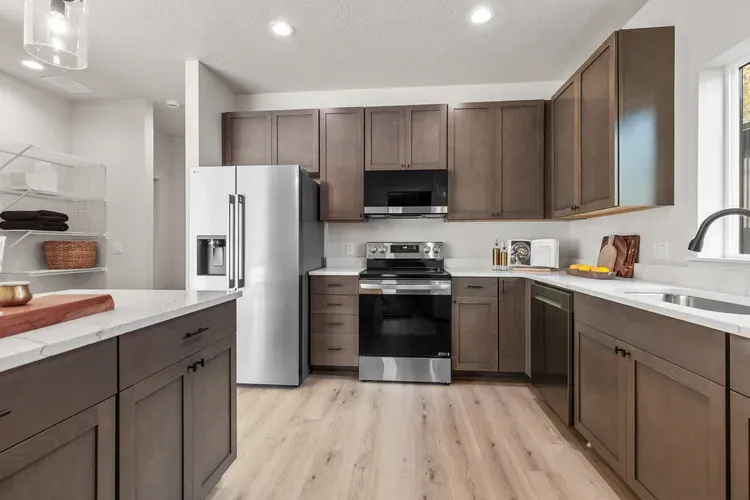
A complete structural package usually covers the engineered plan set stamped for your jurisdiction, the precut framing package, wall and roof sheathing, windows and exterior doors, roofing, siding, and insulation matched to local energy code. That’s the common shape of it, and it’s roughly what our overview of kit homes describes.
The word “usually” is doing real work in that sentence. There’s no industry standard for what a kit contains, which is exactly why the comparison problem exists. Get the itemized list in writing before you put any two numbers side by side.
Why two kit homes prices can differ by tens of thousands
When similar-looking houses come back with very different quotes, it’s almost always one of these five things:
- Scope. The most common gap by far. A framing-only package and a full dry-in package are different products wearing the same word.
- Spec level. “Windows included” and “Milgard Low-E windows at U-0.29 included” are not the same promise, and the difference shows up in your heating bill for thirty years.
- Plan stamping. A generic plan set costs less than one engineered and stamped for your jurisdiction’s snow and seismic loads. You’ll pay for the stamp eventually, so a quote without it isn’t cheaper.
- Delivery. Sometimes included, sometimes freight at cost, sometimes quietly absent. On a long haul, that’s a meaningful line.
- Model and footprint. The obvious one, and usually the smallest of the five.
Notice that four of the five have nothing to do with the house itself. That’s why the cheapest quote in your inbox is so often the least complete one.
The price-per-square-foot trap
Price per square foot is a fine sanity check on a large house and a misleading one on a small house. Kitchens and bathrooms carry most of the cost per square foot in any home, and a compact house has the same kitchen and bathroom as a bigger one spread across fewer feet.
So a small kit will look expensive per square foot and still be the cheaper house to build and to heat. Compare total delivered package prices for the specific models you’re considering, then look at what each one costs to finish. Our comparison of kit home vs stick-built cost over time takes the same idea further out, because the purchase price and the thirty-year cost don’t rank sellers in the same order.
How to make two quotes comparable
Ask every seller the same short list, in writing:
- What’s in the package, itemized line by line?
- What’s explicitly excluded?
- Is delivery to my address included, and at what freight assumption?
- Is the plan set stamped for my jurisdiction?
- What are the named products for windows, roofing, siding, and insulation?
- How long is this price held, and what triggers a change?
Then build the two quotes back up to the same scope on paper. If seller A includes windows and seller B doesn’t, price B’s windows and add them before you compare. Nine times out of ten the gap shrinks to something modest, and occasionally it flips.
What sits outside every kit price
No kit price is a finished-house price. The land, survey and excavation, foundation, utility connections, permits and impact fees, interior finishes, and labor for the licensed trades all sit outside the package, at every company.
Site conditions move that outside number more than your model choice does, which is why an honest seller won’t quote you a finished price sight unseen. For the full picture, our breakdown of the total cost of a kit home covers what falls inside the $100K to $120K range and what stacks on top, and prefab home kits prices works through the same question from the prefab side.
Kit homes prices FAQ
Is there a kit homes price list I can just look at?
Most sellers publish package prices by model, and those are genuinely useful for narrowing your shortlist. What nobody can publish is your finished cost, because your lot decides a large share of it. Treat a price list as the starting line, not the answer.
Why won’t a seller quote me a finished price over the phone?
Because they’d be guessing at your foundation, your utility runs, your permit fees, and your soil. Anyone willing to give you a firm finished number without seeing the site is either padding it heavily or setting up a change order later. A range with the assumptions written down is the honest version.
Do kit homes prices include the foundation?
Almost never. The foundation is site work, it’s poured by a local contractor to your engineered plan, and it varies with soil, slope, and frost depth. If a quote appears to include it, read that line closely, because it’s unusual enough to be worth confirming.
The bottom line
Kit homes prices are package prices, and the useful comparison isn’t which number is smallest but which scope is complete. Get itemized lists, match them to the same scope, confirm the plan stamp, and check the named products before you weigh anything.
If you’d like a package price for a specific model and a straight read on what your lot in Idaho or eastern Washington would add on top, give us a call. You can also browse what’s available on our kit homes for sale page.