Yes, you can build an ADU in Post Falls. The city has allowed accessory dwelling units on single-family lots for years, and it’s actually one of the more ADU-friendly cities in Idaho right now. When the state legislature was debating SB 1354 earlier this year, Post Falls was specifically cited as a city that had already been voluntarily cutting its ADU barriers before the state stepped in.
That’s a meaningful distinction. While other Idaho cities were pushing back against the new state housing laws, Post Falls was already moving in the right direction. If you own a home in Post Falls and you’ve been thinking about a backyard cottage, a rental unit, or an in-law suite, here’s exactly what the rules look like right now and what changes starting July 1, 2026.
| Local Rules Are Changing July 1, 2026
Post Falls’ current ADU code will be affected by Idaho’s SB 1354, which takes effect July 1, 2026. The city has until February 1, 2027 to update its local code. This article explains both what’s in place now and what changes. Before you submit a permit application, verify current requirements with Post Falls Community Development at (208) 773-8708. |
Does Post Falls Allow Detached ADUs?
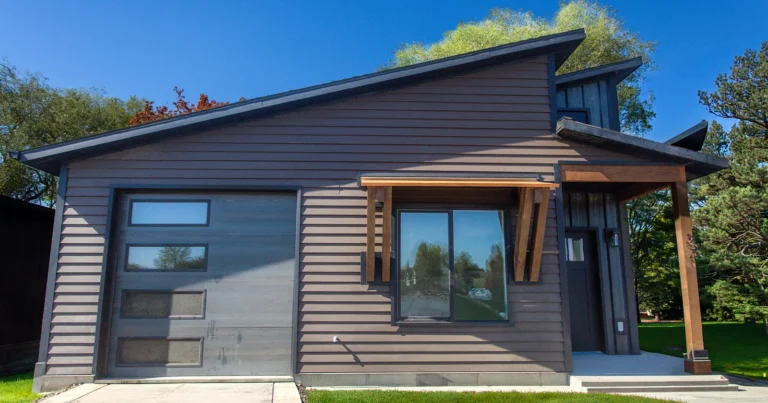
Yes. Post Falls allows both attached and detached ADUs on single-family residential lots. A detached ADU is a completely separate structure on the same property as your primary home, with its own electricity, kitchen, and sanitary facilities. The most common version is a backyard cottage or a converted garage.
Post Falls handles ADU permits through its Community Development Department. Permits are processed as a plan review, not a public hearing or discretionary approval process, which keeps the timeline more predictable than it would be in cities with more complicated approval requirements.
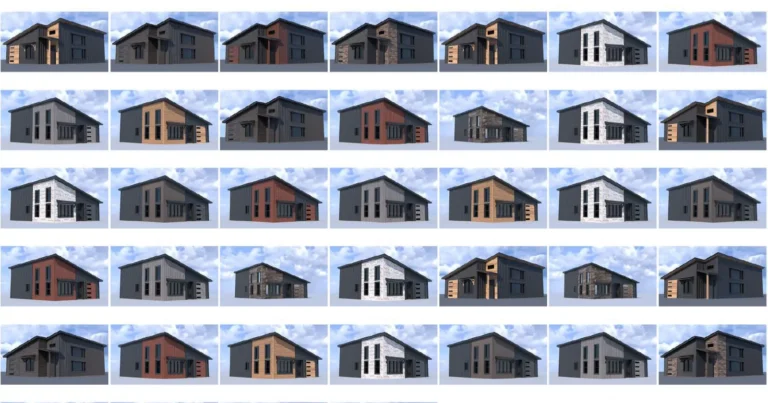
The city also participates in the Housing Solutions Partnership’s free ADU plan program. Four pre-approved plan sets are available at no cost to homeowners in the Post Falls area. Using one of these plans can streamline your permit review since the structural elements have already been vetted by local building officials.
Post Falls ADU Rules at a Glance
Here are the key requirements under Post Falls’ current code. Some of these will shift after July 1, 2026 when SB 1354 takes effect, which we’ll explain in the next section.
| Requirement | Current Post Falls Rule | Changes After July 1? |
| Maximum size | 50% of primary home’s living area or 1,000 sq ft, whichever is smaller | Yes. SB 1354 sets a minimum of 1,000 sq ft, which conflicts with the 50% rule for larger homes |
| ADUs per lot | One ADU only | No change; SB 1354 also protects one ADU per lot |
| Parking | One additional paved off-street parking space required | Likely changes; SB 1354 restricts parking mandates in most cases |
| Design compatibility | Materials must match the primary residence | May be affected; SB 1354 limits overly restrictive design standards |
| Entrance visibility | No more than one entrance visible from the street | Check with city after July 1 update |
| Driveways | No separate driveway unless accessing rear alley or side street | Check with city after July 1 update |
| Placement | Must be behind primary residence; corner lots may use street-side yard | SB 1354 also requires rear yard placement |
| Owner occupancy | Not required by current Post Falls code for long-term rentals | SB 1354 further prohibits any such requirement |
Size: The 50% Rule and the 1,000 Square Foot Cap
Post Falls caps ADU size at either 50% of your primary home’s living area or 1,000 sq ft, whichever is smaller. In practice, this means the cap varies with your home’s size.
If your home is 1,600 sq ft, 50% is 800 sq ft. Since 800 is smaller than 1,000, your ADU is currently capped at 800 sq ft. If your home is 2,200 sq ft, 50% is 1,100 sq ft. Since 1,100 is larger than 1,000, the 1,000 sq ft cap applies. In either case, the city takes whichever number is smaller.
After July 1, 2026, SB 1354 flips this on its head. The new state law sets a minimum protected ADU size of 1,000 sq ft, or 75% of your primary home’s floor area, whichever is larger. A city can no longer impose a cap below that floor. For Post Falls homeowners with homes under about 1,334 sq ft where 50% falls below 1,000, the state law will override the local cap.
Parking: One Additional Space Currently Required
Post Falls currently requires one additional paved off-street parking space when you add an ADU. Your existing parking for the primary home still needs to be maintained as well. This is simpler than Coeur d’Alene’s three-stall requirement, but it’s still a requirement that will need to fit on your lot.
SB 1354 restricts cities from requiring off-street parking for ADUs in most circumstances. Post Falls’ current one-space requirement is likely to change when the city updates its code by February 2027. Check with Community Development for the current status before planning your project.
Design Compatibility: Materials Must Match
Post Falls requires that ADU building materials be consistent with the primary residence. This means your backyard cottage should generally look like it belongs with the main house, not clash with it. This is a common and reasonable design standard, and it’s worth discussing with your architect or contractor early so it doesn’t create redesign work later.
Placement: Behind the Primary Residence
Detached ADUs in Post Falls must be located behind the primary residence. Corner lots get a bit more flexibility: if your lot corners on two streets, you can also place the ADU in the street-side yard. For most standard lots, the backyard is your working area.
Setback requirements vary by zoning district. Your permit submittal will need to show that the ADU meets the setbacks required in your zone. Pull up your property on the Post Falls GIS map or call Community Development to confirm the setbacks that apply to your specific address before you finalize your plans.
No Separate Driveway
Your ADU can’t have its own separate driveway off the street unless it’s accessing a rear alley or a side street. The intent is to preserve the single-family character of the neighborhood and avoid multiple curb cuts on a single lot. If your property backs to an alley, that’s actually an advantage: it gives you a natural access point for the ADU without the restriction applying.
One Entrance Visible From the Street
Post Falls limits your ADU to no more than one entrance visible from the street. This is another measure to maintain the appearance of a single-family property from the street view. In practice, most detached rear-yard ADUs satisfy this automatically since they’re placed behind the main house and their entrances face the backyard.
What Changes After July 1, 2026
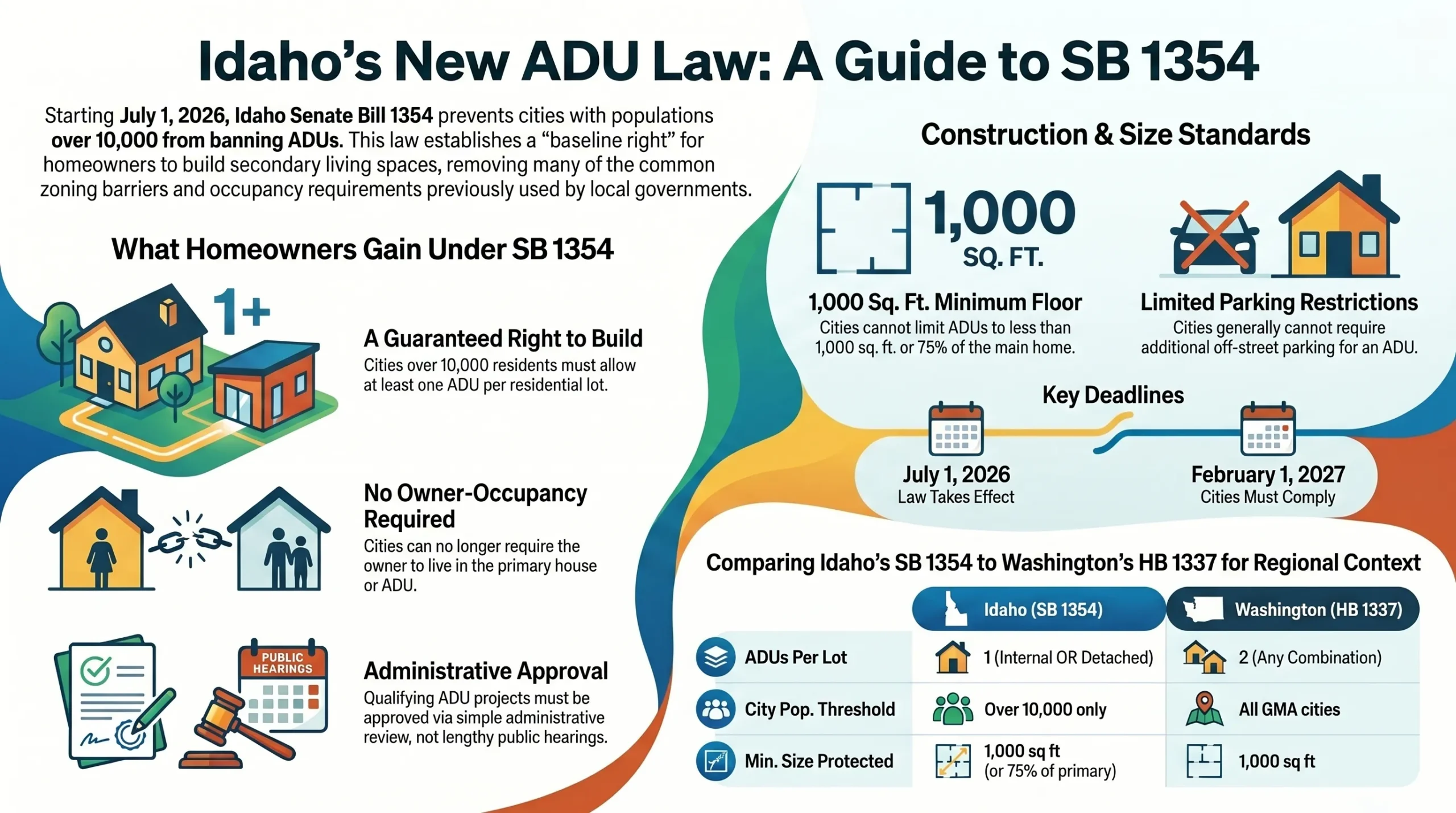
Post Falls was ahead of many Idaho cities in loosening ADU restrictions voluntarily. That doesn’t mean SB 1354 leaves everything in place. A few of the city’s current requirements directly conflict with the new state law, and those will need to change.
| Post Falls Is Ahead of the Curve on ADU Reform
When Idaho legislators debated SB 1354, Post Falls was cited specifically as a city that had already been voluntarily reducing ADU barriers before the state required it. That’s a genuinely good sign for homeowners here. The compliance process should be smoother in Post Falls than in cities that have been more resistant to ADU expansion. |
Size Minimum Rises Under SB 1354
SB 1354’s size formula sets a floor that supersedes any local cap that falls below it. Cities must allow ADUs of at least 1,000 sq ft, or 75% of your primary home’s floor area, whichever number is larger.
Here’s what that means in Post Falls specifically. If your home is 1,200 sq ft, the current 50% rule limits you to 600 sq ft. Under SB 1354, the 1,000 sq ft floor applies since 75% of 1,200 is only 900 sq ft, which is below 1,000. Your protected minimum doubles. If your home is 1,600 sq ft, current code would cap you at 800 sq ft. Under SB 1354, 75% of 1,600 is 1,200 sq ft, which is larger than the 1,000 sq ft baseline. Your protected minimum is now 1,200 sq ft. For most Post Falls homeowners, SB 1354 meaningfully expands the ADU you’re legally allowed to build.
Parking Requirement Likely Goes Away
SB 1354 restricts cities from mandating off-street parking for ADUs in most situations. There are narrow exceptions: if your primary home has no off-street parking of its own, if the street in front of your property is unpaved and not designed for on-street parking, or if your home is within a quarter mile of a transit stop or commercial area.
For most Post Falls residential properties, those exceptions don’t apply. The one-space parking requirement Post Falls currently enforces is likely to come off when the city updates its code. That said, don’t rely on that assumption before confirming with Community Development, since the city has until February 2027 to finalize its updated code.
Owner Occupancy: Already Not Required in Post Falls
This is one area where Post Falls was already ahead of the state law. The city doesn’t currently require you to live on the property to build or rent an ADU for long-term tenants. SB 1354 reinforces this by prohibiting cities from adding such a requirement. If you want to rent your ADU while living elsewhere, that’s allowed under both current code and the incoming state law.
Setbacks and Height Get a Parity Standard
SB 1354 requires that ADU setbacks and height limits be no more restrictive than what the city applies to regular single-family homes in the same zone. Whatever your zone requires for a house applies to your ADU. CIties can’t invent tighter standards just because a structure is classified as an ADU. The rear-yard placement requirement stays since it’s written into the state law itself.
Does Your Property Qualify?
Before you get too far into planning, here are the key questions to work through.
Are You Inside Post Falls City Limits?
Post Falls’ ADU rules only apply to properties within city limits. Some properties have a Post Falls mailing address but actually sit in unincorporated Kootenai County. Your address and your zoning jurisdiction aren’t always the same thing. If you’re not sure, check the Post Falls GIS map at the city’s website or call Community Development to confirm your parcel’s jurisdiction.
| Unincorporated Kootenai County Has Different Rules
If your property is outside Post Falls city limits, the city’s ADU code and SB 1354 don’t apply to you. Kootenai County has its own standards for unincorporated land. Contact Kootenai County Planning and Zoning to find out what’s allowed on your property. |
Is Your Lot Set Up for a Single-Family Home?
Post Falls’ ADU rules apply to single-family residential lots with one primary home. If your lot has a different designation or already has multiple dwelling units, check with the Planning Division before assuming an ADU is available to you.
Is There Space in the Rear Yard?
Work through the geometry before you get attached to a plan. The ADU needs to sit behind the primary residence with the required setbacks from property lines, and you also need to fit the required off-street parking space (under current code). Look at your property survey, confirm the setback requirements for your zone, and sketch out whether the footprint you want actually fits.
Post Falls lot sizes vary significantly by neighborhood and subdivision. Newer developments on the east and north sides of the city tend to have more room in the rear yard. Older neighborhoods closer to the city core sometimes have tighter constraints. Don’t assume until you’ve mapped it out.
Is There an HOA or CC&R Restriction?
SB 1354 updates Idaho’s HOA statute so that your HOA can’t add new anti-ADU restrictions or enforce ones created after your purchase date without your written consent. But if your CC&Rs already prohibited ADUs when you bought your home, those restrictions can still be enforced. Check your CC&Rs before you invest time in planning. If you’re not sure what your documents say, a real estate attorney can review them quickly.
How to Get an ADU Permit in Post Falls
ADU permits in Post Falls run through the Community Development Department at City Hall, 408 North Spokane Street. Here’s how the process works.
Step 1: Figure Out Your Setbacks and Zone
Before you finalize any plans, confirm the setback requirements that apply to your specific address and zoning district. Call Community Development at (208) 773-8708 or use the Post Falls GIS map to look up your parcel. Setbacks vary by zone, and you need the right numbers before you can confirm whether your planned footprint fits.
Step 2: Choose Your Plans
You have two options. The Housing Solutions Partnership offers free pre-approved ADU plan sets designed to meet Post Falls’ building codes. These plans are ready to go through the review process faster since the structural elements are already vetted. Note that the Scout plan set has mandatory engineering requirements, so review that carefully before choosing it.
If you want a custom size, layout, or design that doesn’t fit the pre-approved options, hire an architect, home designer, or engineer to produce plans for your specific project. Custom plans take longer to review but give you full control over the result. If you’re targeting a size above the current 800-1,000 sq ft range under SB 1354’s new minimums, custom plans are likely your path.
Step 3: Assemble Your Permit Submittal
Your ADU permit application for Post Falls needs to include:
- A detailed site plan showing property boundaries, setbacks, existing structures, and the proposed ADU with dimensions and square footage
- Compliance documentation for zoning requirements including lot coverage, height limits, and setbacks
- Mechanical plans
- Truss sheets
- Any required engineering, particularly if using the Scout pre-approved plan set
Applications can be submitted through the Post Falls Community Development portal or in person at City Hall. Check the current portal at postfallsid.portal.opengov.com for online submission options.
Step 4: Plan Review and Approval
Post Falls processes ADU permits as an administrative plan review, not a public hearing. Your application goes through staff review for code compliance. Timeline depends on current workload and how complete your submittal is. Using a pre-approved plan set generally speeds up the structural review portion.
Step 5: Build and Inspect
Once your permit is approved, you’ll go through the standard inspection sequence for new construction: foundation, framing, rough electrical and plumbing and mechanical before any covering, insulation, and a final inspection before occupancy. Post Falls uses the 2018 International Building Codes.
What Kind of ADU Makes Sense in Post Falls?
Post Falls is a fast-growing city with a mix of lot sizes and neighborhood types. Here are the most common ADU configurations that work well here.
Backyard Cottage
A standalone structure in the rear yard with its own entrance, living space, kitchen, and bathroom. The most versatile configuration: works for rental income, a family member, or a caretaker. Currently capped at 50% of your home or 1,000 sq ft, whichever is smaller; minimum protected size rises to 1,000 sq ft or 75% of your home under SB 1354 after July 1.
Converted Garage or Accessory Structure
Post Falls allows existing garages and accessory structures to be converted to ADUs if they can meet current building codes. This is often a cost-effective path if you’ve got a detached garage that’s underused. The converted structure still needs to satisfy size, setback, height, and design requirements, and will go through a full building code review for the interior systems.
Garage Plus Living Space
A new structure that combines a garage or workshop with finished living quarters above or beside it. Popular in Post Falls given how many residents have equipment, vehicles, or hobby space they want to keep covered. The garage portion doesn’t count against the ADU size limit, so you get both.
Post Falls Is Kit Culture’s Backyard. Here’s What We Offer.
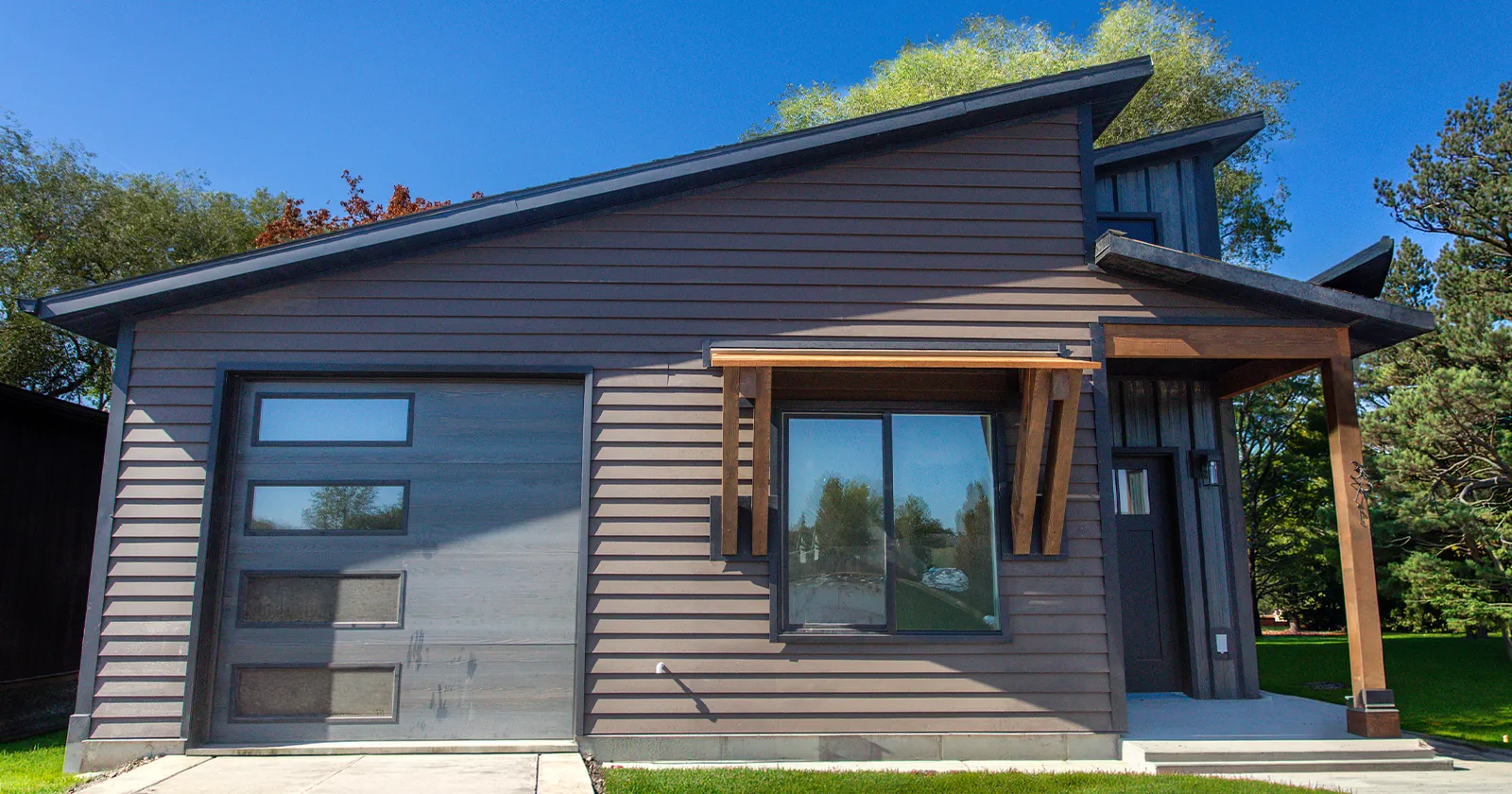
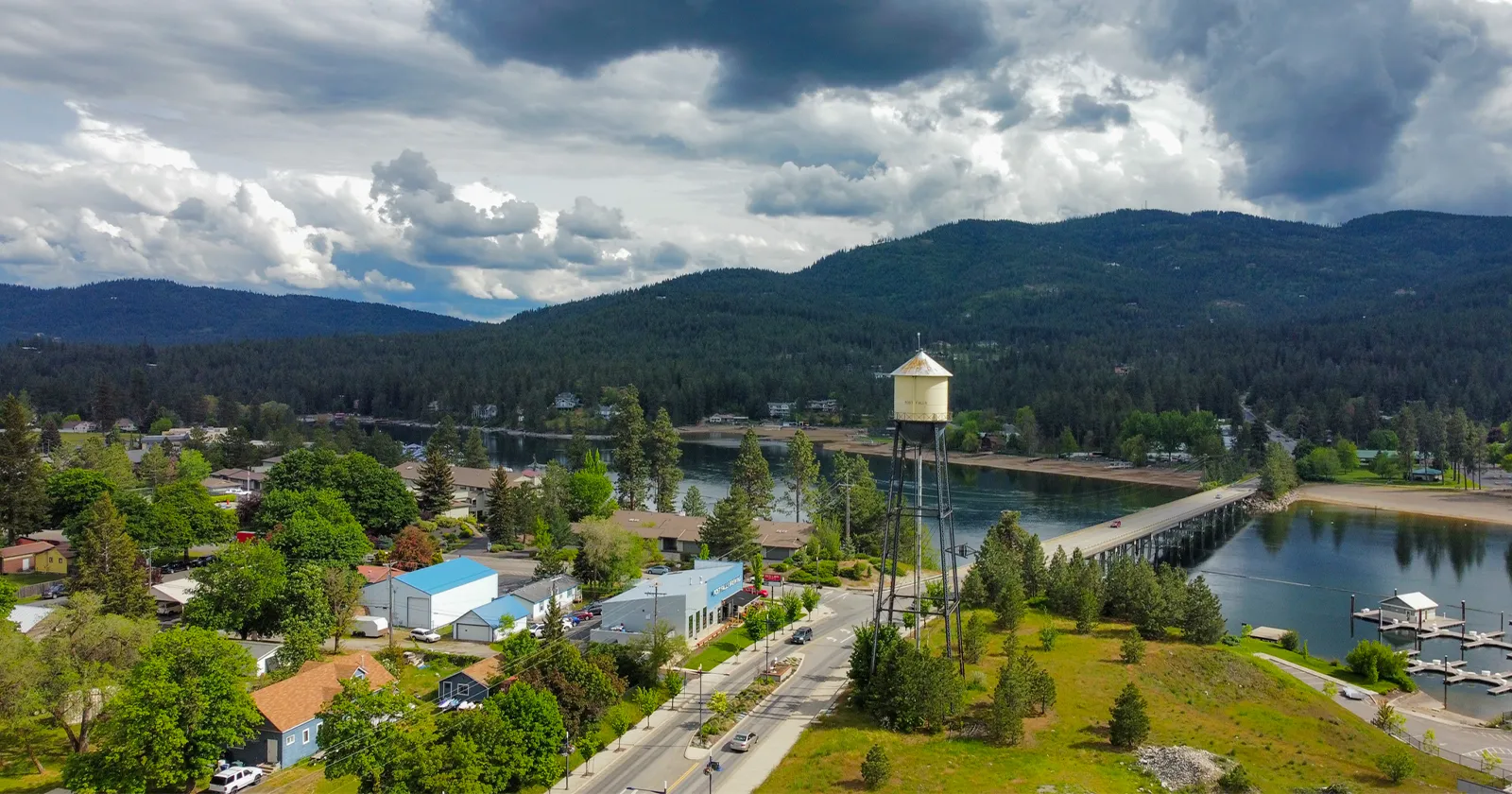
Kit Culture is based right here in Post Falls. We’re not guessing at how this market works. We know the neighborhoods, we know the lot patterns, and our team has direct familiarity with how local permitting moves.
Kit Culture is an Idaho-made kit home system built on the same manufacturing platform as Metal America, one of the most established metal panel producers in the Northwest. Every home ships permit-ready on a single truck, with pre-cut framing components, engineered drawings already stamped for Idaho, and a complete package of premium finishes included from day one. That means LG appliances, quartz countertops, Milgard windows, a multi-zone ductless heat pump, LVP flooring, and a 40-year metal roof and siding system.
Price is where it gets genuinely interesting for Post Falls homeowners. Custom-built detached ADUs in North Idaho typically run $180,000 to $300,000 or more. Kit Culture ADU models come in at roughly half that cost, with premium finishes already included. That’s not a budget option with corners cut. It’s a more efficient way to build: manufacturing components at scale in a controlled facility and shipping them ready to assemble simply costs less than coordinating a custom build from scratch on your lot.
Build time is the other major difference. Most Kit Culture homes are weather-tight within days of delivery and move-in ready in under 90 days. Compare that to 9 to 18 months for a comparable custom project.
| Kit Culture ADU Models Coming in 2026
We’re developing three ADU-specific models designed for detached backyard placement. Made in Idaho, shipped permit-ready, backed by a 40-year structural warranty. Get on the waitlist at kitculturehomes.com for early access pricing and priority production slots. |
Kit Culture sells direct to homeowners. If you’d rather have a licensed local GC manage the build, our contractor pricing program gives local builders trade pricing so they can make money on the project while you still pay well under what a custom build would cost. Your contractor handles the site work and local permitting. We handle everything that arrives on the truck.
| We’re Right Down the Road. Let’s Talk.
Our team knows Post Falls and we know what a realistic ADU project looks like here. If you’re ready to explore your options, we’d love to have that conversation. Visit kitculturehomes.com or give us a call. We can walk you through the models, the permitting process, and what it would look like on your specific lot. |
Frequently Asked Questions
Are ADUs allowed in Post Falls?
Yes. Post Falls allows both attached and detached ADUs on single-family residential lots. The city has had ADU rules in place for years and was voluntarily easing those rules even before Idaho’s SB 1354 was passed.
How big can my ADU be in Post Falls right now?
Under current Post Falls code, your ADU can be no larger than 50% of your primary home’s living area or 1,000 sq ft, whichever is smaller. So if your home is 1,400 sq ft, your max is 700 sq ft. If your home is 2,200 sq ft, your max is 1,000 sq ft. After July 1, 2026, SB 1354 sets a minimum protected size of 1,000 sq ft or 75% of your primary home’s square footage, whichever is larger. That overrides any local cap that falls below it.
Do I need extra parking for an ADU in Post Falls?
Under the current code, yes. One additional paved off-street parking space is required when you add an ADU. SB 1354 restricts cities from requiring parking for ADUs in most situations, so this requirement is likely to change after July 1, 2026 when the city updates its code. Confirm the current status with Community Development before planning your project.
Does my ADU have to look like my main house?
Under current Post Falls code, yes. Building materials must be consistent with the primary residence. This may be affected by how Post Falls updates its code after SB 1354 takes effect, since the state law limits overly restrictive design standards.
Can I put a driveway in for my ADU?
Not unless you have access to a rear alley or side street. Post Falls doesn’t allow a separate driveway from the main street to the ADU. If your property backs to an alley, you can use that for ADU access. Otherwise, the ADU shares the existing driveway and parking setup.
Can I rent my ADU out in Post Falls?
Yes. Post Falls doesn’t require owner-occupancy for long-term rentals, and SB 1354 further prohibits cities from adding such a requirement. You can rent your ADU as a long-term rental without living on the property. For short-term rentals under 30 days, check Post Falls’ local short-term rental ordinance since those rules are governed separately.
Do I need to live on the property to build an ADU?
No. Post Falls doesn’t require owner-occupancy to build or rent an ADU for long-term use. This puts Post Falls ahead of cities that still had those requirements before SB 1354 removed them statewide.
What are the free ADU plans and where do I get them?
The Housing Solutions Partnership worked with local building officials and planners to develop four pre-approved ADU plan sets that are free to use in Post Falls and the surrounding Kootenai County area. You can access them through the Post Falls Community Development page or at housingni.org. Note that the Scout plan set has mandatory engineering requirements, so review it carefully before choosing it. These plans can speed up your permit review since the structural elements are pre-approved.
My property is in unincorporated Kootenai County near Post Falls. Do these rules apply?
No. Post Falls’ ADU rules and SB 1354 both apply to properties within city limits. If your parcel is in unincorporated county land, you’re under Kootenai County jurisdiction. Contact Kootenai County Planning and Zoning to find out what you can build.
Who do I contact at the City of Post Falls for ADU questions?
Community Development Department, 408 North Spokane Street, Post Falls, ID 83854. Phone: (208) 773-8708. Office hours are 8 a.m. to 5 p.m. Monday through Friday. You can also submit permits and access GIS mapping through postfallsid.portal.opengov.com.