Search prefab homes low cost and you’ll turn up numbers that look too good to be true. Most of them are, but not because anyone’s lying. They’re kit prices, and a kit price isn’t a house price.
The honest answer is that prefab does save money, the savings are smaller than the headline numbers suggest, and they come from somewhere specific. Here’s where.
Why prefab homes low cost claims need a second look
A number that seems impossibly cheap is usually one of three things: a shell-only kit with no interior, a kit that excludes windows and doors, or a kit price quoted with no freight. None of those are scams. They’re just partial products being compared against a finished house.
The other thing those numbers leave out is your lot. Land, excavation, foundation, septic or sewer, well or water hookup, power, and permits happen no matter how the house is built. They can rival the structure itself on a difficult site, and no kit company can quote them sight unseen. We laid out the full stack in the total cost to build a kit home with a contractor.
Where the savings genuinely come from
Speed. This is the big one. A compressed framing stage means fewer weeks of construction loan interest, fewer weeks of general conditions, and fewer weeks of paying two housing costs while you wait. On a build measured in months, that adds up faster than most people expect. How long it takes to build a kit home has the timeline detail.
Less waste. Components are cut to size in a controlled setting. You’re not paying for a dumpster full of offcuts, and you’re not paying a framing crew to solve problems on site in the rain.
Fewer change orders. The design is settled before anything ships. Change orders are where conventional builds quietly bleed budget, and a kit removes most of the opportunities for them.
Predictability. A fixed package price for the structure means one large line item that won’t move. That’s worth real money in a market where lumber prices swing.
Where the savings don’t come from
Not from cheaper materials. A kit built to local code uses the same lumber, the same insulation values, and the same window specs a conventional builder would use. If a kit is cheap because the materials are thin, that’s a warning sign rather than a bargain.
Not from skipping trades. Electrical, plumbing, and HVAC are licensed work either way, at the same local rates.
Not from the foundation. Concrete costs what concrete costs.
Not from operating costs, automatically. Energy performance comes from the envelope spec, not from the construction method. A well-built kit and a well-built conventional house perform the same. The Department of Energy’s guidance on efficient home design is a good reference for what to ask about, and we cover our own spec in kit home insulation and windows.
The choice that moves your budget most
Square footage. It outweighs almost everything else on this page.
Every additional square foot carries framing, roof, siding, insulation, flooring, and conditioned air with it. Going from a two-story family home down to a compact cottage footprint changes the budget more than any finish decision you’ll make. That’s why the smallest models are where the genuinely affordable builds happen, and it’s why our 799 sq ft Cottage gets the most interest from buyers working to a number.
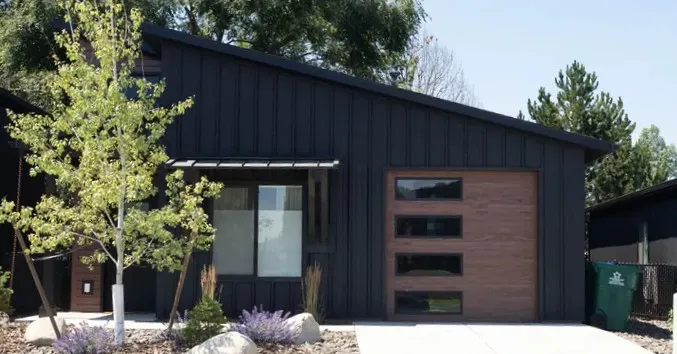
A simple footprint helps too. Corners, dormers, and complicated rooflines all cost money in materials and labor. A clean rectangle with a straightforward roof is the cheapest good-looking house you can build.
Idaho and Washington considerations
Two local factors matter here. First, cold-climate code means a real insulation and window package, so don’t budget against a spec you’d see in a mild climate. Second, if you’re building an accessory dwelling unit, recent law in both states has widened what’s allowed, and an ADU on land you already own skips the largest single cost in most projects. See Idaho’s ADU law or our Idaho build guide depending on which applies to you.
Frequently asked questions
Are prefab homes cheaper than stick-built?
Usually, though the margin is narrower than headline numbers suggest, and it comes mostly from time and waste. We compared them over a full ownership period in kit home vs stick-built cost over time.
What’s the cheapest way to get into a prefab home?
Build small on land you already have, keep the footprint simple, and take on some of the finish labor yourself if you have the time. Those three decisions do more than any discount hunting.
Does a low cost prefab home hold its value?
A kit home on a permanent foundation is appraised as site-built construction and follows the local market like any other house. Location and finish quality drive resale far more than the build method does.
The bottom line
Prefab is a real way to build for less, but the savings are in speed, waste, and predictability rather than in cheap materials. The buyers who end up happiest are the ones who budgeted for the whole project, land and site work included, and then chose a smaller, simpler house on purpose.
If you want to know what a realistic all-in number looks like for a specific lot in Idaho or Washington, give us a call. We’d rather tell you early than have you find out at the foundation stage.